
Compute Network
The Compute Network is the layer of Sentio Nodes that executes processors. It turns raw on-chain data into structured, indexed datasets and serves real-time computation, aggregation, and analytics in coordination with the Storage Network.
Role in the Architecture
Each Compute Node (also called an indexer) runs one or more processor replicas. A processor describes what to read from chain and how to transform it; the Compute Network is responsible for actually running that program, keeping it caught up to the head, and writing its output into the Storage Network.
The Compute Layer and Storage Layer scale independently. A processor may run as multiple replicas on different continents while its data is replicated to nearby Storage Nodes that do not run the processor itself.
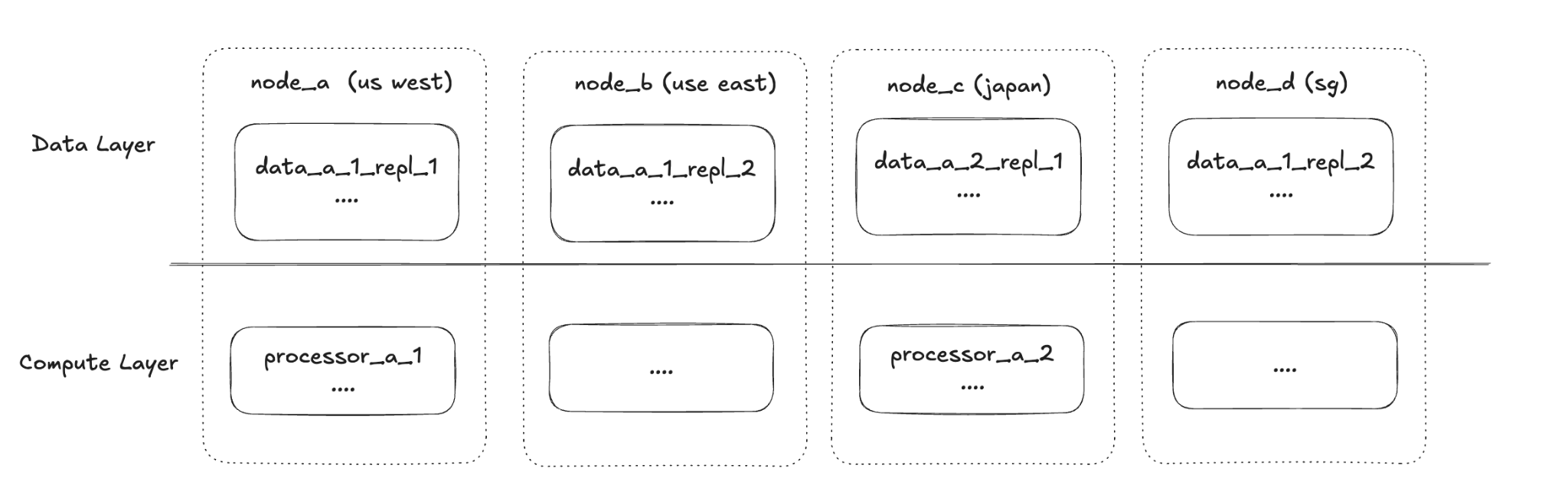
Independent scaling of Compute and Storage layers across nodes
Processor Lifecycle
Processors are first-class on-chain objects. Their lifecycle is driven by two contracts on Sentio EVM:
| Contract | Purpose |
|---|---|
ProcessorRegistry | Records processor identity, owner, IPFS bundle CID, required chains. |
Controller | Starts/stops processors and assigns each one to an eligible indexer. |
The flow:
- Upload — the processor bundle is pinned to IPFS and a CID is produced.
- Create —
ProcessorRegistry.createProcessorregisters the processor on-chain. - Start —
Controller.startProcessorschedules execution;Controllerselects an indexer based on stake, capacity, and SU cost (see Tokenomics). - Run — the assigned indexer downloads the bundle, runs it, and writes results to the processor's database in the Storage Network.
- Stop —
Controller.stopProcessor(string)halts execution. Only the processor owner, an operator of the owner, or an explicit processor admin can start or stop a processor.
For the operational commands and CLI flags, see Access the Network.
Replicas and Capabilities
Each processor replica is identified by ${processorId}_${replicaIndex}. Today every processor runs as a single replica (replicaIndex = 0); the schema is forward-compatible with multi-replica deployments where the same processor runs in multiple regions for availability and lower latency.
Indexers advertise their capabilities (supported chains, hardware tier, region) at registration. Controller only assigns a processor to indexers whose capabilities match the processor's required-chain-id set.
Node JSON-RPC
Every indexer exposes a JSON-RPC server on its compute-node RPC port (advertised via IndexerRegistry) for inspecting processor execution. The endpoint is location-transparent: hitting any indexer for a processor not local to it forwards the request to whichever indexer hosts the processor.
| Method | Returns |
|---|---|
sentio_nodeStatus | Node identity + sync status: node type, indexer ID, current block, head block, registered capabilities. |
sentio_processorStatus | Per-chain progress for a processor: processed block / timestamp, state (CATCHING_UP / PROCESSING / …), SDK version, entity schema. |
sentio_processorLogs | Recent driver logs for a processor (paged via limit + cursor). |
For example invocations, see Access the Network.
Billing
Indexing work is metered in Sentio Units (SU) and billed to the processor owner via the Billing contract:
- Each new data point produced by the processor consumes a fixed SU amount (see Tokenomics).
- The SU-to-$ST exchange rate is set by the assigned indexer at job-start time and is locked for one month for that processor, giving developers price predictability.
- If the owner's Billing balance runs out, the processor is paused until it is topped up.
Query fees, by contrast, are billed to the query initiator and are described in the Storage Network chapter.
Updated 3 months ago