
Network Participation
The Sentio Network is powered by multiple stakeholders. Each role has distinct responsibilities and incentives, ensuring a balanced and sustainable ecosystem.
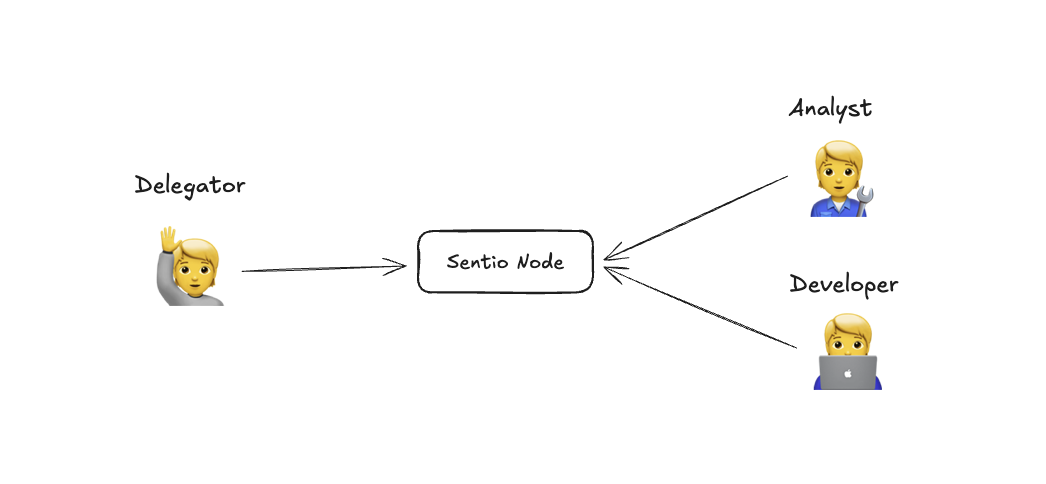
Network participants: Delegators, Analysts, and Developers interact with Sentio Nodes
Developers & Analysts
What they do:
- Upload processors (analytics workflows) to the network.
- Consume indexing, query, and RPC services.
Why they participate:
- Access transparent, decentralized analytics infrastructure.
- Avoid vendor lock-in and opaque SaaS pricing.
How to get started:
- Write a processor using the Sentio SDK (TypeScript) or Subgraph syntax.
- Test and validate the processor locally.
- Upload the processor to the Sentio Network — it gets stored in the Object Store (e.g. IPFS) and assigned to nodes.
For processor development guides, see the Processors section.
Sentio Node Operators
What they do:
- Run processors, store data in DB, and serve queries.
- Provide access to Sentio contracts.
- Compete to provide reliable and low-latency services.
Why they participate:
- Earn SU for every indexing and query job served.
- Receive delegated stake from token holders to scale operations.
- Gain reputation, leading to more workload assignments.
How to get started:
- Stake $ST tokens to the network via the Controller smart contract.
- Set up the required hardware and software infrastructure.
- Install and run the Sentio Node software.
- Configure your SU cost — jobs are preferentially assigned to nodes with lower SU costs.
For details on staking and job assignment, see Tokenomics.
Stakers / Delegators
What they do:
- Stake $ST tokens directly or delegate to Node Operators.
- Share in revenue generated by the nodes they support.
Why they participate:
- Earn passive income via revenue sharing.
- Contribute to network security and decentralization.
- Support trusted Node Operators without running infrastructure themselves.
How to get started:
- Acquire $ST tokens.
- Choose a Node Operator to delegate to — consider their reputation, uptime, and commission rate.
- Delegate your tokens via the staking interface.
Stake changes take effect at the beginning of the next epoch, not immediately.
Updated 7 months ago
What’s Next
Did this page help you?