
🌐 Sentio Network
Sentio Network extends the Sentio platform by moving its storage and processor layers into a decentralized network. Instead of being operated by a single service provider, data storage and processor execution are handled by a distributed set of network participants. This enables verifiable data pipelines and aligned incentives for node operators, developers, and end-users — while preserving the developer experience and tooling that have made Sentio widely adopted.
Core Principles
Developer-First & Modular
Sentio is purpose-built for builders. Processors, dashboards, and alerts are designed to be intuitive, composable, and fast — so teams can go from idea to production without wrestling with low-level blockchain plumbing.
The network features a fully modular architecture with multiple layers. These layers are designed to function both in close coordination and as standalone components.
Trustless & Incentive-Aligned
Sentio eliminates reliance on centralized providers by distributing indexing and governance across independent node operators. Powered by the $ST token, economics are transparent and usage-driven. This ensures reliability, resilience, and sustainable growth of the ecosystem.
AI-Native
The entire Sentio ecosystem is powered by AI. Natural-language queries, automated debugging, and predictive analytics are integrated into the workflow. Through the MCP (Model Context Protocol) service layer, developers can build custom AI assistants that seamlessly consume blockchain observability data and extend into agent-based applications.
Architecture
The broader Sentio ecosystem consists of three main components: Processors, the Sentio Network, and various Applications.
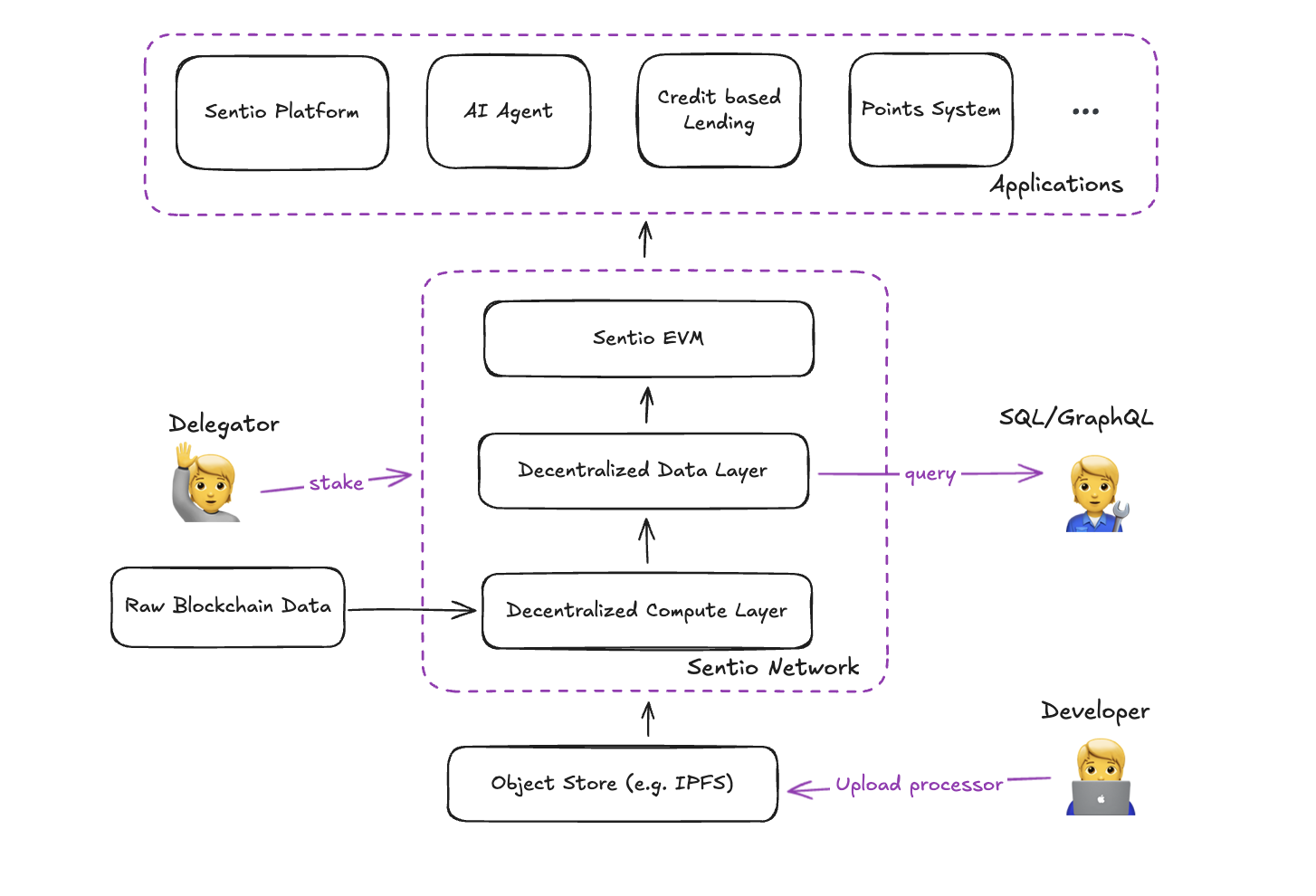
Sentio Network Architecture
Processor
At the heart of Sentio is the Processor — a user-defined program that transforms raw blockchain data into structured, actionable insights. Processors define what contracts to watch, how to react to events, and what data to output.
For details on building processors, see Processors in the Collect Data section.
Sentio Network
A decentralized network of Sentio Nodes organized into three independent layers:
| Layer | Role |
|---|---|
| Compute Network | Executes processors for real-time computation, aggregation, analytics, and supports streaming, alerting, and visualization in coordination with the Storage Network. |
| Storage Network | Stores blockchain and processor-indexed data, accessible via APIs or SQL-like queries. |
| Sentio EVM | Built on top of OP Stack. Stores metadata of the Storage Network and Compute Network, provides staking and voting mechanisms, and offers precompiled contracts to access data on-chain. |
The Compute Network and Storage Network can scale independently. For example, a processor might have two replicas running on different continents. Data generated by each processor can also be replicated to different nodes in nearby locations, even if those nodes are not running that specific processor. This design offers maximum flexibility in terms of availability and cost.
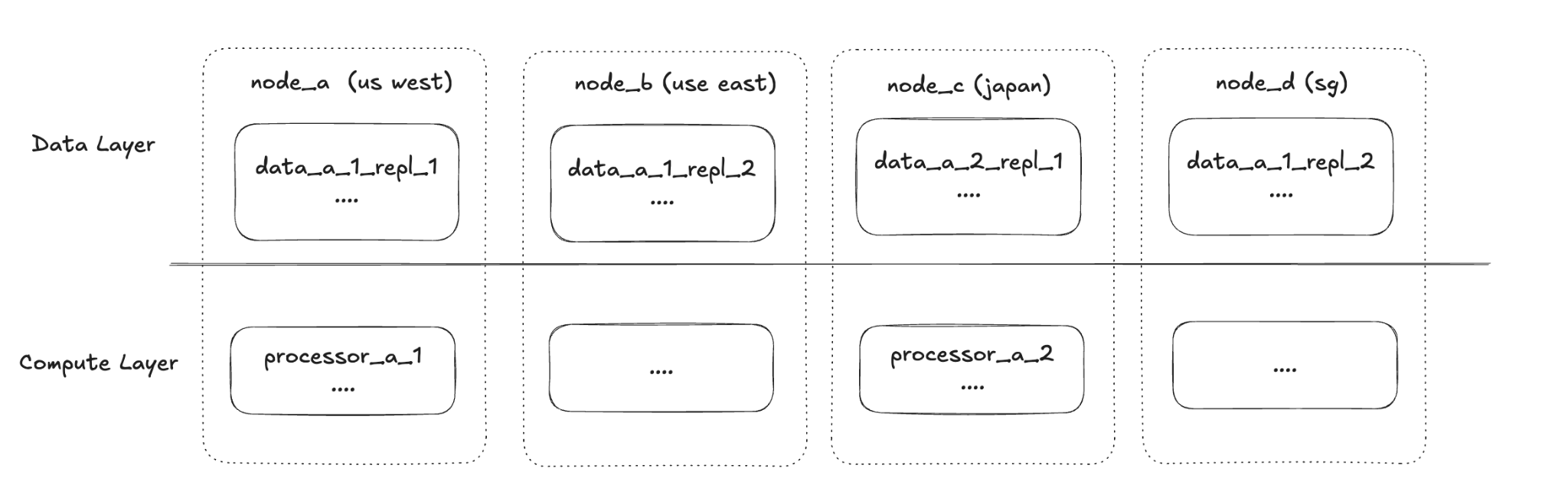
Independent scaling of Compute and Data layers across nodes
Applications
Built on top of the Sentio Network, multiple applications can be developed, including but not limited to:
- Sentio Platform: Provides intuitive UI and high-level functions to access and utilize the Sentio Network. The current centralized Sentio service will be migrated to the open platform.
- AI Applications: Sentio indexed data can be directly consumed by AI models or agents as a high-quality, structured data layer, enabling intelligent analysis, automation, and decision-making.
- Decentralized Apps: Applications that utilize Sentio indexed data, e.g. a credit-based lending protocol that considers lenders' historical debt repayment behavior, or a transparent points program that communities can track and verify.
Network Participants
The Sentio Network is powered by three types of participants:
| Role | Responsibility | Incentive |
|---|---|---|
| Developers & Analysts | Build and upload processors; consume indexing, query, and RPC services | Access transparent, decentralized analytics infrastructure |
| Sentio Node Operators | Run processors, store data, serve queries | Earn SU for every job served; gain reputation for more assignments |
| Stakers / Delegators | Stake or delegate $ST tokens to node operators | Earn passive income via revenue sharing |
For more details on each role, see network-participation.
What's Next
- Litepaper — Download the full Sentio Litepaper (PDF).
- Compute Network — Processor lifecycle, replicas, and indexer JSON-RPC.
- Storage Network — Database types, on-chain permission model, and query authentication.
- Network Participation — Find out how to participate as a Developer, Node Operator, or Staker.
- Tokenomics — Explore the $ST token, Sentio Units, job assignment, and incentive model.
- Access the Network — Operational steps to fund, upload, and query.
Updated 4 months ago